
Best Spring Wildflower Hikes in Washington (By Region + Bloom Timing)
Spring wildflower season in Washington is short — maybe eight to ten weeks total if you follow it correctly. It starts in the sun-baked Wenatchee foothills and along the Columbia River Gorge, where yellow balsamroot and purple lupine light up the hillsides while the high country is still buried under snow.
These aren’t the alpine meadows you see all over Instagram. Spring wildflowers in Washington mean desert ridgelines, open slopes, big sky, and wide river views. Lower, warmer, sunnier trails that wake up first after a long gray winter.
For the past five years, I’ve driven east or south every April chasing whatever is peaking — camping in the car, waking up before sunrise, and rotating trails depending on bloom reports.
If you time it right, spring might be the most underrated hiking season in the entire state.

When Is Wildflower Season in Washington?
Spring wildflowers unfold in elevation waves:
March–April
- Wenatchee foothills
- Olalla Canyon
- Sage Hills
April–May
- Columbia River Gorge (WA + OR)
- Dalles Mountain Ranch
- Lyle Cherry Orchard
- Dog Mountain (mid-May peak)
Late May–June
- Methow Valley lower elevations
- Southwest Washington (Silver Star early beargrass)
Peak bloom varies year to year depending on snowpack and temperature.
Before you go:
- Check Washington Trails Association trip reports
- Check recent bloom photos in the PNW Wildflowers Facebook group
Timing is everything.
Wildflower Etiquette (Please Read This)
Spring wildflower ecosystems are fragile. One bootprint can crush an entire patch.
- Stay on established trail.
- Don’t pick flowers.
- Don’t step into fields for photos.
- Pack out everything.
These areas survive because hikers respect them.
What to Bring for Wildflower Hikes
Most of these trails are short, exposed, and hot by midday. Here’s what I actually carry:
Footwear — Eastern Washington trails are rocky and dry. I wear the La Sportiva Bushido III for grip on dry rocky terrain.
Trekking poles — helpful on steeper trails like Dog Mountain and Sauer’s Mountain. I use Black Diamond Trail Ergo Cork.
Discover Pass — Required for Washington state parks including Dalles Mountain Ranch. Get it here.
Sun protection. There’s zero shade on the Eastern Washington trails and most of the Gorge hikes. A wide-brim hat and real sunscreen (not the SPF 15 from 2019 in your glovebox) are non-negotiable. I wear my favorite sun shirt the OR Astroman Hoodie on every spring hike.
Water — more than you think. The Wenatchee and Gorge trails are fully exposed and can hit 80°F+ by noon in late April. I bring at least 2 liters for anything over 3 miles. I always pack my Osprey 3L bladder.
A real camera or a decent phone lens. I say this in the closing and I mean it — wildflower scale doesn’t translate on a phone screen. If you shoot with your phone, a clip-on wide angle lens helps.
Layers for wind. The ridgeline trails (Horse Lake, Sage Hills, Silver Star) get hammered by wind even on warm days. A packable wind shell takes up no space and saves the hike. My fav is the Patagonia Houdini Hoodie.

Columbia River Gorge (Washington Side)
The Gorge is Washington’s most reliable early-season bloom. South-facing slopes warm quickly, and balsamroot explodes across the hillsides.
These trails get busy. Go early or midweek if you can.
👉 For detailed trail breakdowns, bloom timing strategy, parking tips, and Oregon-side hikes, see my full Columbia River Gorge Wildflower Guhttps://www.thetrekkingmama.com/best-spring-wildflower-hikes-in-the-columbia-river-gorge/ide.

Dalles Mountain Ranch – Columbia Hills State Park, WA
6.4 miles | 1,200 ft gain | April–May
Rolling hills, historic farm ruins, and Mount Hood glowing behind fields of yellow. One of the most photogenic spring hikes in the state. Discover Pass required.

Lyle Cherry Orchard – Columbia River Gorge, WA
6 miles | 1,500 ft gain | April–May
Steady climb through open slopes and oak woodland with sweeping river views. Less crowded than Dog Mountain but just as beautiful. Fully exposed — bring water.

Dog Mountain – Columbia River Gorge, WA
7.8 miles | 2,800 ft gain | Mid-May peak
Relentless climb. Legendary summit bloom. On a clear day with peak balsamroot, it’s hard to beat. Weekend permits required during peak season.
Columbia River Gorge (Oregon)
Most hikers combine both sides in one weekend. The timing is identical and the drive between trailheads is minutes.
If you’re pairing wildflowers with waterfalls, see my full guide to Spring in the Columbia River Gorge: Waterfalls, Wildflowers & Where to Stay.

Memaloose Hills – Columbia River Gorge, OR
📍 Mosier, OR
3.5 miles round trip
900 ft gain
Best time: April–early May
Memaloose was one of my first wildflower hikes, and it hooked me immediately. The summit area is nice, but the real show is the fields on the way up — in mid-April the balsam root is so thick you can barely see the trail edges, with lupine mixing in for that classic yellow-and-purple palette against the Gorge backdrop.
It’s quieter than Rowena or Tom McCall most days, especially midweek. If you want flowers without the traffic, this is the move.
Good to know: Fewer crowds than neighboring Rowena or Tom McCall. A great intro to Gorge wildflower hiking.

Rowena Crest Viewpoint – Columbia River Gorge, OR
📍 Mosier, OR
0.5–2 miles round trip
200–500 ft gain
Best time: April–early May
Rowena is less of a hike and more of a place to wander. You park, walk a few hundred feet, and you’re standing above meadows of balsam root with the Columbia River cutting through basalt cliffs below. Short loops wind through the wildflowers, and you can spend twenty minutes or two hours depending on how deep you go.
This is a no-brainer easy stop for pictures — that’s what everyone does, and honestly, it works. The cliffs and flowers frame together in a way that’s hard to get wrong, especially at sunrise when you’ll have the overlooks mostly to yourself.
Good to know: Part of the Tom McCall Preserve — stay on trails to protect the wildflowers. Easy to combine with Tom McCall Point if you want more elevation.

Tom McCall Preserve – Columbia River Gorge, OR
📍 Mosier, OR
3.4 miles round trip
1,100 ft gain
Best time: April–early May
Tom McCall adds real elevation to the Rowena area, and the payoff scales with the effort. The trail climbs through wildflower meadows to a ridgeline with big Gorge views, and the optional push to McCall Point gives you an exposed viewpoint where the wind and the scale of the canyon hit you at the same time.
In peak bloom, the color variety is noticeably wider here than at lower-elevation trails — balsam root, lupine, paintbrush, all layered across the slopes. It’s the best flower-to-effort ratio in the Gorge if you want an actual hike rather than a viewpoint stroll.
We did this one at sunset, and the push to McCall Point was worth every step. Mount Hood was right there, blanketed with flowers in every direction, and we had the whole place to ourselves. It’s probably the most rewarding hike on this entire list for the effort — that final stretch delivers in a way that’s hard to describe until you’re standing in it.
Heads up: Watch for rattlesnakes, especially on the warmer exposed sections.
Good to know: Gets busy on weekends. Early morning or weekday for a calmer experience. Dogs not allowed. Trail closed November 1–March 31 to protect sensitive habitat.
Wenatchee Area
Wenatchee is where spring actually starts in Washington. While the west side is still gray and dripping, the foothills east of the Cascades are already turning gold. Balsam root blooms here weeks before the Gorge, and the sunshine-to-effort ratio is absurd.
Olalla Canyon Ridge
📍 Cashmere / Dryden, WA (Wenatchee Valley)
4 miles round trip
1,000 ft gain
Best time: March–May
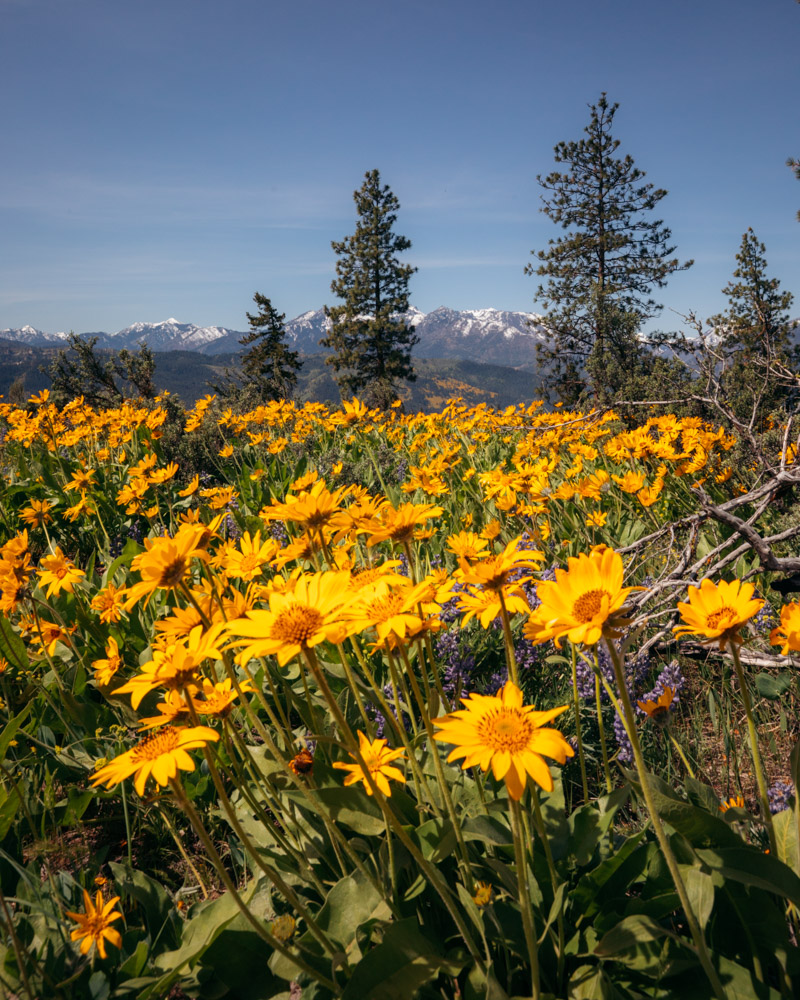
A wind-carved canyon that opens into the kind of Eastern Washington scenery most west-siders don’t know exists — basalt walls, golden grass, big sky in every direction. In spring the slopes light up with balsam root and lupine. In fall it all turns copper. Either way, it’s a lot of landscape for four miles.
The trail is short but has some punch to it. No shade anywhere, and rattlesnakes are common once it warms up — stay alert and start early.
I hit Olalla during a superbloom and it was incredible — flowers covering every slope, color everywhere you looked. It was also packed with people, so get there early if you want any solitude.
Sage Hills
📍 Wenatchee, WA
3–7 miles (choose your distance)
500–1,200 ft gain
Best time: April–May
Sage Hills is a choose-your-own-adventure situation. The trail network spreads across rolling foothills above Wenatchee, and you can do a quick three-mile loop or link ridgelines into a longer route with Cascade views the entire way. In April, the whole system turns yellow.
Fair warning: this is also mountain bike territory, and the shared-use trails see heavy bike traffic on weekends. Hike early for quieter condition
Horse Lake Reserve
📍 Wenatchee, WA
6–8 miles
1,200–1,500 ft gain
Best time: April–June
Horse Lake feels more like Eastern Oregon than the Cascades — rolling shrub-steppe with long sightlines and not a tree in sight. The trail climbs steadily through open hills and eventually gives you Stuart Range views that seem too big for a trail this close to town.
Wildflowers here peak later than Olalla and Sage Hills, so this is a good May or early June option when the lower trails have already browned out. The tradeoff: it’s fully exposed, often windy, and there’s no water or shade for the entire route.
Leavenworth Area
The hills above Leavenworth bloom a few weeks after the Wenatchee foothills — late April into May — and what they lack in early-season timing they make up for with Enchantments views as a backdrop. This is balsam root with snow-capped granite behind it.
Sauer’s Mountain
📍 Peshastin, WA (near Leavenworth)
6 miles round trip
2,000 ft gain
Best time: Late April–May
Sauer’s Mountain blew me away. Wildflowers for days, Enchantments views in the background, and enough uphill to make the post-hike snack feel earned. It’s easily one of my favorite spring hikes in Washington — and the best part is you don’t have to drive all the way to the Gorge.
The trail is straightforward but gains 2,000 feet, so it’s a real hike, not a stroll. The meadows open up as you climb and just keep going — rolling yellow hillsides with snow-covered peaks behind them.
I went up to shoot a Title Nine collab and the whole ridge was in bloom. Beautiful — but busier than I expected at the summit. Lots of people, which is a good sign that the word is out on this trail.
Good to know: Parking is very limited — arrive early. This is private land, so be extra respectful: stay on trail, pack everything out, and follow all posted guidance. No pass required.
Southwest Washington
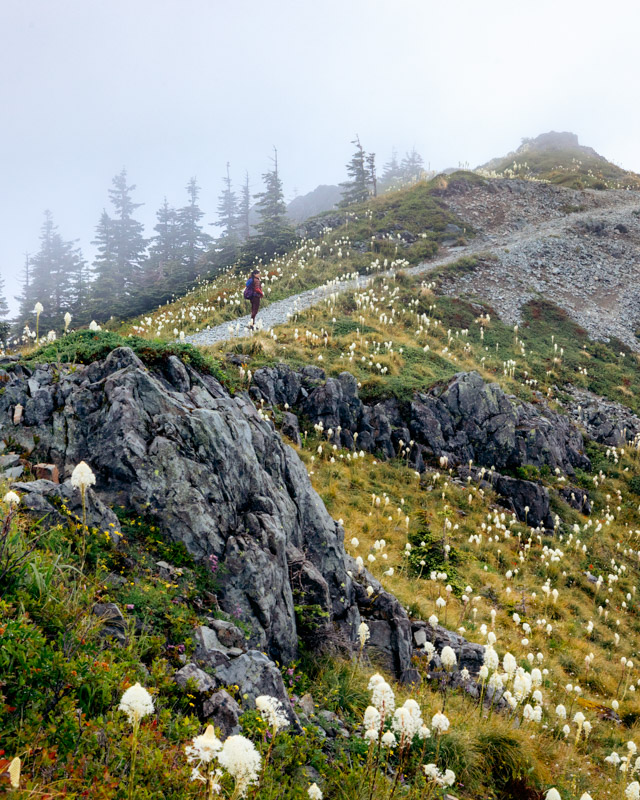
Silver Star Mountain is a different kind of wildflower hike. No balsam root, no desert steppe — instead you’re chasing beargrass, which turns this ridge into something out of a Dr. Seuss book every June.
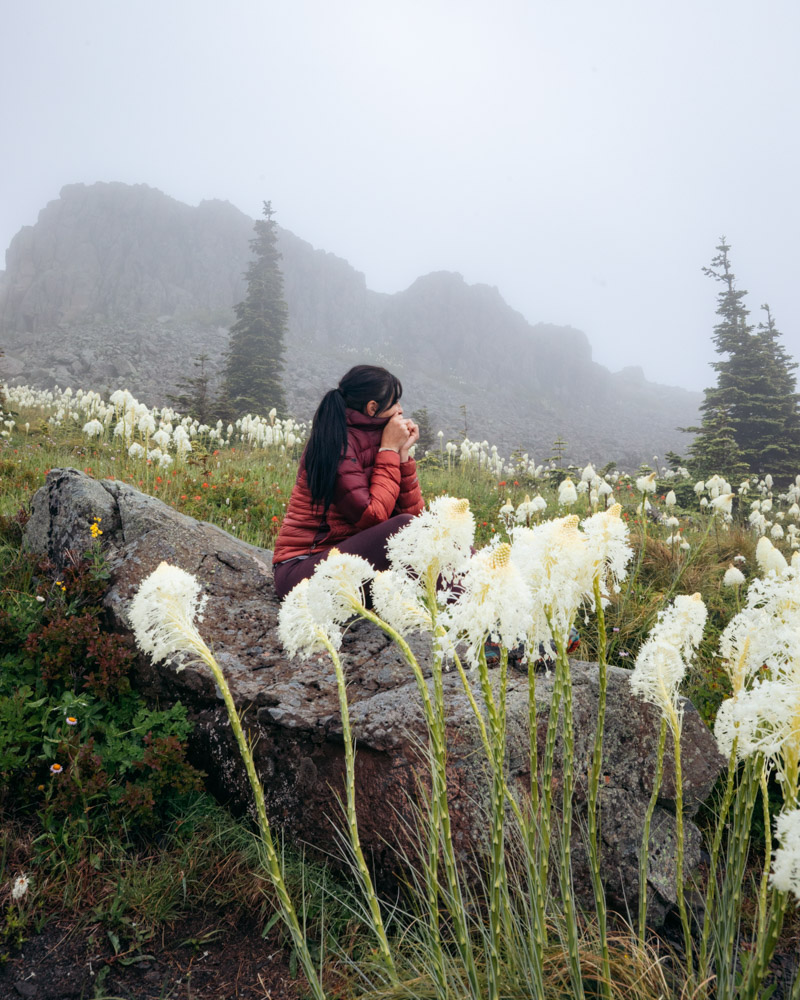
Silver Star Mountain (Ed’s Trail)
📍 Washougal, WA
5 miles round trip
1,200–1,500 ft gain
Best time: Mid-June–July
The beargrass on Silver Star is unlike anything else in Washington. Those white poofs — they really do look like Dr. Seuss flowers — cover the hillsides and make the whole forest feel enchanted. On a clear day you get Hood and St. Helens in the background. On a socked-in day, the ridge goes moody and atmospheric, and it’s still magic.
The road to get there is the catch. FR 4109 is rough, rutted, and genuinely requires high clearance. Don’t attempt it in a sedan.
Fair warning: there are two ways to get to the trailhead, and I took the wrong one. The muddy one. The road had a solid foot of mud, and I ended up parking my car and walking the last stretch in. But the beargrass superbloom at the top was worth every minute of stress on that road.
Good to know: No fees, no restrooms. Dog-friendly. Check road conditions before driving out — FR 4109 is not maintained and can be impassable early in the season.

Methow Valley
Best time: Late May–mid June
The Methow Valley is wildflower season’s grand finale. By the time the Gorge and Wenatchee have browned out, the sunny slopes above Winthrop and Mazama are peaking — balsam root and lupine on every ridge, with the kind of long, golden light that makes photographers lose track of time.
We’ve camped at Pearrygin Lake twice for wildflower season, and the sunsets alone are worth the drive.
👉 4 Awesome Methow Valley Spring Wildflower Hikes
Final Thoughts
Spring wildflower season in Washington is short — maybe eight weeks from the first Wenatchee balsam root to the last beargrass on Silver Star. But those eight weeks are some of the best hiking of the year: sunshine when the west side is still gray, color everywhere, and trails that are genuinely uncrowded compared to summer.
Follow the bloom uphill and north as the season progresses. Check WTA trip reports and the PNW Wildflowers Facebook group before you go. And bring a real camera — phone photos don’t do the scale justice.
If I had to pick one moment to show someone what spring in Washington looks like, it would be standing on Tom McCall Point at sunset with Mount Hood and nothing but flowers between me and the horizon.